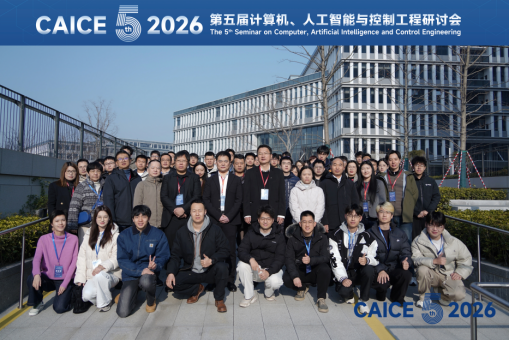

The 5th International Conference on Computer, Artificial Intelligence and Control Engineering (CAICE 2026) was successfully held from January 23 to 25 at the Hangzhou Institute of Technology, Xidian University. Centered on the theme of "Computer, Artificial Intelligence, and Control Engineering," the conference brought together leading experts, scholars, and industry professionals from both domestic and international backgrounds. Featuring a hybrid format that combined online and offline participation, the event provided a high-level platform for academic exchange and intellectual collaboration. Sponsored by Xidian University and organized by Hangzhou Institute of Technology, the conference’s opening ceremony was chaired by Professor Chen Chen, with Deputy Dean Ming Li delivering the welcome address on behalf of the host institution.
Deputy Dean Ming Li, Hangzhou Institute of Technology, Xidian University |
Professor Chen Chen, Hangzhou Institute of Technology, Xidian University |


Seven renowned experts and scholars from home and abroad delivered a series of outstanding keynote speeches at the conference. Professor Dusit Niyato from Nanyang Technological University, Singapore, proposed an Agentic AI and agent-based framework to address challenges such as the static nature of edge intelligence. Professor Lin Cai from the University of Victoria, Canada, explored ubiquitous mobile intelligence to promote cross-domain intelligent collaboration across air, land, and water. Professor Celimuge Wu from the University of Electro-Communications, Japan, integrated fuzzy logic with deep reinforcement learning to develop a neuro-symbolic edge intelligence paradigm. Professor Zhiguo Shi from Zhejiang University provided an in-depth analysis of the ZZB theory for radar parameter estimation. Professor Liping Qian from Zhejiang University of Technology introduced a distributed collaborative reasoning approach to optimize energy consumption and accuracy in edge intelligence networks. Professor Hangguan Shan of Zhejiang University conducted research on UAV surveillance and perception mobile networks based on Integrated Sensing and Communication (ISAC) technology. Professor Congfeng Jiang from Hangzhou Dianzi University presented FLUXLog, a federated hybrid expert framework designed to enhance privacy and domain adaptability in log anomaly detection. These presentations combined academic rigor with practical significance, offering a rich intellectual feast for both the on-site and online audiences.
Professor Dusit Niyato |
Professor Lin Cai |
Professor Celimuge Wu |
Professor Zhiguo Shi |
Professor Liping Qian |
Professor Hangguan Shan |
Professor Congfeng Jiang |
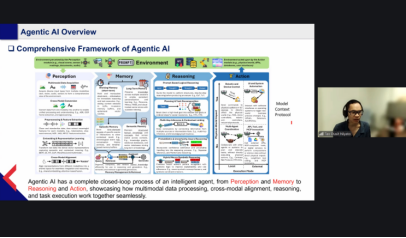


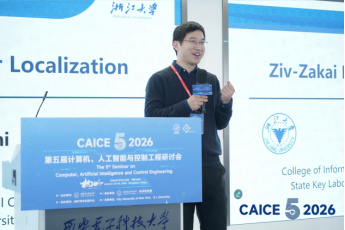

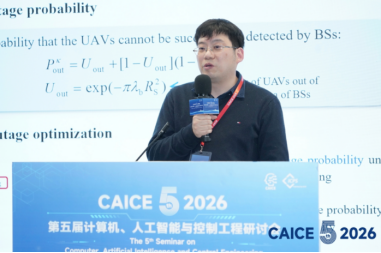

To promote targeted communication within specialized subfields, the conference featured two main parallel sessions. Subforum One, titled "Artificial Intelligence and Intelligent Algorithm Systems (AIAS)," and Subforum Two, titled "Data Intelligence and Information Processing (DIIP)," showcased a total of 18 oral presentations. The participating scholars consecutively shared their latest research findings and engaged in active discussions. The topics covered a wide range of dimensions, including innovative applications of intelligent algorithms across multiple scenarios, as well as the development and practical exploration of data intelligence technologies. These sessions fully demonstrated the technological achievements and broad development prospects of the related fields across various industries.

The closing ceremony featured an awards ceremony and banquet to recognize outstanding academic achievements, including “Best Papers,” “Best Presentations,” and “Best Posters.”
 |  |  |
As a major academic conference in the fields of computer science, artificial intelligence, and control engineering, the successful hosting of the Fifth CAICE Conference has injected new momentum into innovation and development across these disciplines. Moving forward, the conference will continue to serve as a vital bridge, gathering global expertise to foster deeper integration among industry, academia, and research. It will contribute significantly to advancing intelligent technologies and facilitating their practical implementation.